
Wednesday, 30 November 2011
New secondhand bike stall in Lower Marsh


Tuesday, 29 November 2011
Westminster Council and congestion
There's an excellent article in the Standard that explains the need for car sick Westminster to have its streets totally totally jammed with cars - it's what allows them to set a low Council Tax. Lambeth by contrast has much less available parking so more people walk, cycle and use public transport.
What the article doesn't point out is how cheap it is for Westminster residents to park their car, with an annual permit for a 1200cc plus car costing a mere £115 online.
In Lambeth's congestion zone area the cost is between £136 and £247 for equivalent vehicles (you'll pay more for your V8 Range Rover than in Westminster) if you live inside the Congestion Zone, and £149 to £260 outside it.
The knock on effect to Lambeth residents of Westminster's addiction to drivers is Vauxhall gyratory and its ilk.
Monday, 28 November 2011
Drinking water fountains for Waterloo Station?
At the Vauxhall, Nine Elms, Battersea exhibition the other day I discovered (when a person I gave my name to said 'Ah, it's you') that over fifty people had written in response to Lambeth's consultation asking for drinking water fountains to be installed. I'd written this post and sent it around a bit.
Iwas told that this was the issue cited most often by respondents to the consultation on the Waterloo plans (which shows how few people generally comment) and the Project Manager told me,
I still have to go through a process on the Waterloo documents and expect to be able to publish the final versions in February. As it stands, my intention is to include something on drinking fountains to address the point you made.
Well done to all those who sent an email - let's hope we see free water, prominently positioned and delivered by tap rather than lorries, at Waterloo soon.
By coincidence I'm talking for 7 1/2 minutes about drinking water fountains at the next Movement for Liveable London Street Talks on 6th December.
An exciting tube project in Vauxhall (beyond the Northern line)
The BBC reports today the Governments multi-billion pound investment programme, including the Northern Line extension to Battersea, saying the government will consider allowing local authority borrowing against the Community Infrastructure Levy to support the scheme, subject to a commitment from a developer to contribute and develop the site.
It's a different tube project that I want to talk about:

One of the most inspiring things I heard at the Vauxhall, Nine Elms, Battersea (VNEB) exhibition is the research undertaken into having the rubbish from all the new buildings removed by vacuum tubes rather than dust carts.
It sounds like science fiction but Sweden's Envac have 50 years experience of doing just this. And if it still sounds fanciful for this huge development project, they're working right this moment on a project of equivalent scale in Helsinki - with recycling thrown in of course.
How can this kind of scheme be encouraged and nurtured? The obvious starting point is to impose a limit on motor traffic, a vehicular 'gastric band'. That will bring this kind of imaginative thinking from pipe dream to pipe reality. Good grief, you'd even see drinking fountains and taps at railway stations as the sane replacement to lorry transported bottled water .
There's a load of guff talked by Boris about equality - giving people the choice to choose their mode of transport. The reality is that most kids and many other people would love to cycle to get to where they want to go but don't because the volume and speed of motor traffic,the lousy road layout, and the aggression of drivers make it an unequal option.
The way to liberate people to cycle and walk in the city is quite simply to throttle motor traffic and give the direct and easy route to the cyclist and pedestrian. Limit the capacity to the motorist, make them go around a maze or the M25 to get to their destination. But give the cyclist and pedestrian their desire line; give them cashpoints and drinking fountains, attractive shop frontages (or better, book and stuff library frontages) and riverside views. Put in loads and loads of hire bike docking stations.
Sure there'll still be a quantity of really unavoidable motor traffic but a lot will simply evaporate, as the dust cart example shows, and as the Netherlands have proven.
There are wider actions too, including making sure the planning regulations support local businesses, by providing affordable housing and workshop space alongside the swish apartments, rather than forcing them out of town resulting in vans and lorries trundling for miles and miles through residential streets just to get to inner London.
The plans for residential properties need to nurture active travel. If it's easier to jump in the car or in a cab than on the bike the design is failing.
VNEB can be the new Amsterdam.
A really good first action to implement in the next month or two with a bit of white paint and a couple of signs is for TfL take away one of the southbound lanes on Vauxhall Bridge from motor traffic so that the UNBELIEVABLY DIRE cycle lane becomes a delightful wide cycling boulevard instead. I've used the cycle lane twice recently on weekdays at 3.30pm and it made everything clench up. I can't believe that anyone responsible for roads could conceivably have cycled it and not immediately condemned it. What were the traffic 'engineers' who dreamt up such a monstrosity thinking, and why wouldn't a cycle friendly Mayor dramatically improve it immediately?
It's a different tube project that I want to talk about:
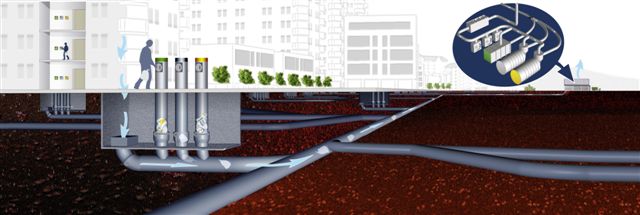
One of the most inspiring things I heard at the Vauxhall, Nine Elms, Battersea (VNEB) exhibition is the research undertaken into having the rubbish from all the new buildings removed by vacuum tubes rather than dust carts.
It sounds like science fiction but Sweden's Envac have 50 years experience of doing just this. And if it still sounds fanciful for this huge development project, they're working right this moment on a project of equivalent scale in Helsinki - with recycling thrown in of course.
How can this kind of scheme be encouraged and nurtured? The obvious starting point is to impose a limit on motor traffic, a vehicular 'gastric band'. That will bring this kind of imaginative thinking from pipe dream to pipe reality. Good grief, you'd even see drinking fountains and taps at railway stations as the sane replacement to lorry transported bottled water .
There's a load of guff talked by Boris about equality - giving people the choice to choose their mode of transport. The reality is that most kids and many other people would love to cycle to get to where they want to go but don't because the volume and speed of motor traffic,the lousy road layout, and the aggression of drivers make it an unequal option.
The way to liberate people to cycle and walk in the city is quite simply to throttle motor traffic and give the direct and easy route to the cyclist and pedestrian. Limit the capacity to the motorist, make them go around a maze or the M25 to get to their destination. But give the cyclist and pedestrian their desire line; give them cashpoints and drinking fountains, attractive shop frontages (or better, book and stuff library frontages) and riverside views. Put in loads and loads of hire bike docking stations.
Sure there'll still be a quantity of really unavoidable motor traffic but a lot will simply evaporate, as the dust cart example shows, and as the Netherlands have proven.
There are wider actions too, including making sure the planning regulations support local businesses, by providing affordable housing and workshop space alongside the swish apartments, rather than forcing them out of town resulting in vans and lorries trundling for miles and miles through residential streets just to get to inner London.
The plans for residential properties need to nurture active travel. If it's easier to jump in the car or in a cab than on the bike the design is failing.
VNEB can be the new Amsterdam.
A really good first action to implement in the next month or two with a bit of white paint and a couple of signs is for TfL take away one of the southbound lanes on Vauxhall Bridge from motor traffic so that the UNBELIEVABLY DIRE cycle lane becomes a delightful wide cycling boulevard instead. I've used the cycle lane twice recently on weekdays at 3.30pm and it made everything clench up. I can't believe that anyone responsible for roads could conceivably have cycled it and not immediately condemned it. What were the traffic 'engineers' who dreamt up such a monstrosity thinking, and why wouldn't a cycle friendly Mayor dramatically improve it immediately?
Thursday, 24 November 2011
Bus stops rather than a bus station at Vauxhall?
The Vauxhall, Nine Elms, Battersea exhibition at Market Towers tomorrow afternoon is worth a visit. In particular the presentation from Farrells Architects who Lambeth appointed to come up with a framework for Vauxhall. Farrells propose ten urban design principles:
1. Create a clear and legible mental map


9.Bus Stops rather than a bus station.

10. Anticipate future two way streets


TfL were present with a chap who could win prizes for understatement, using language along the lines of 'not very good for cyclists' when describing the Gyratory and 'fairly poor' when describing the existing on-pavement farcility on Nine Elms Lane. They hadn't any plans to show what the cycling provision would be down the line but told me Nine Elms would have shared, but wider, bus come cycle lanes, and wider pavements but with no cycle lane on them; the Linear Park will be cycleable along the length, with shared use rather than a segregated lane for cyclists and it's not intended for commuter cycling; the Riverside Walk will also be for pedestrians and cyclists.
As for the Gyratory, there was still a clear 'Boris' message coming across of the need to allow all options equally rather than prioritising active and public transport over the private car. The TfL chap said they don't have models of the non-essential motor traffic but could easily do that. One to ask for.
It's clear to me that action to make the Vauxhall, Nine Elms, Battersea Opportunity Area great for cycling and walking must start right now, even in small ways while the grand plan is worked on. TfL has shut the shared use pavement under the railway bridge. Rather than helpfully reallocating the nearest of the multiple motor traffic lanes for pedestrians and cyclists to use, Vroom-Vroom TfL send you on a right old dog leg of a diversion. So last century, like the gyratory itself.

Wednesday, 23 November 2011
Loving London at night


and the lights.
Monday, 21 November 2011
Colour choice for Cycle Superhighways
I've just discovered that Mauve dye was invented on Cable Street, now part of CS3. What a shame TfL didn't pick up on that to personalise the paint on this route.
It reminded me that in January 2009, when the Cycling Superhighways were still an unknown thing that I wrote a spoof press release, for a cycling forum, which TfL may wish to refer to in their junctions review:
Details of first London Cycling Super Highway announced.
The Mayor of London, Boris Johnson, and Transport for London have announced plans for cycle highways - a set of twelve high-profile radial routes into and out of Central London that will concentrate cycle flows and provide a fast and efficient way into the centre.
Each route will have a clear identity, e.g. 'Docklands Cycle Highway' or 'Northern Line Cycle Highway', with consistent and easy to follow road markings and signs.
The first to be created is planned to be the Northern Line Cycle Highway, initially between Tooting Broadway in South London and Camden Town in North London. The ambition is that it will open in autumn 2009, with work commencing in the spring.
A spokesman said, "This can be implemented easily and cheaply. The Highway will take the existing TfL Red Route along the A24 from Tooting Broadway past Tooting Bec, Balham, Clapham South, to Clapham Common. It will then take the A3 Red Route past Clapham North to Stockwell.
From Stockwell the Highway will take the route planned for the Cross River Tram, which the Mayor and TFL stated last November will no longer be taken forward. It will follow the A3 through Oval to Elephant and Castle, then cross over Waterloo Bridge to Aldwych and up Kingsway to Mornington Crescent, Euston and Camden Town.
The proposed Cross River Tram was expected to carry 9,000 people per hour per direction in peak periods and the Mayor had committed to assess alternative solutions. The Cycle Highway is able to exceed the capacity of the Tram for a fraction of the cost. As well as conventional bicyles, electric bicycles and mobility chairs will be allowed to use the standard lane-width Highway to ensure the widest range of people can benefit."
In a radical departure from conventional cycle lanes, the Cycle Highway will have dedicated use of the central lanes of the road in each direction and these will be designated with coloured tarmac. There will be marked feeder lanes onto and off the Cycle Highway at each junction for cyclists to merge into the Cycle Highway traffic. All motorised vehicles will use the lanes adjacent to the pavement and will have to give way to cyclists using the feeder lanes.
To avoid lengthy delays at bus stops the old Routemaster buses will be reintroduced, pending delivery of the new design, allowing pedestrians to board and alight whenever the bus is stationary. As cyclists will not be filtering on the inside of the buses the Routemaster design is safe to use.
At most cross-roads motorised traffic wishing to cross the Cycle Highway will have to give way until a suitable gap exists to cross, as will traffic wishing to turn across the Highway. The intention is that cyclists will, with one or two exceptions, not have traffic lights hindering their progress.
Journey time for an average cyclist between tube stations is calculated to be similar to the time taken by tube and faster than existing road traffic.
Ambulances, Fire Engines and Police Cars responding to emergencies will use the Cycle Highway. Motorists will have to stop in their lane and cyclists stop on the edge of their lane or in gaps in the motorised traffic until the emergency service vehicle (which is limited to 30mph on the Highway) has passed.
Boris Johnson, Mayor of London, is understood to want to create original 'Grands Projets' in the manner of former French President Francois Mitterand. Cycling Super Highways, expected to be known colloquially as Bicycle Only Journey Options (BOJOs), are to be his first.
TfL have neither confirmed nor denied that it is intended that the Cycle Highways will have tarmac the colour of the matching tube line on maps. Specialist cycle clothing company Rapha are expected to be interested in sponsoring this first route if the official Northern Line colour can be changed to Metrosexual Pink, through a simple swap with the Hammersmith and City Line, and rumours are now circulating that Rapha/Condor could secure options on the sites of the former Woolworth stores along the routes in a bid to challenge dominant retailers Halfords and Evans. Wiggle were a possible source of sponsorship, as the Highway is likely to form part of the English side of the London to Paris cycle route. However it is now thought that this part of the route is too direct to suit their brand image.
Subscribe to:
Posts (Atom)