Showing posts with label Traffic Reduction. Show all posts

Monday, 29 June 2015

Are so many taxi journeys really needed?


Many streets in Waterloo (such as The Cut) swarm with taxis, frequently making their empty way to the station and I wonder why so many space wasting, air polluting vehicles are needed. Especially on a sunny day like today when a burst water main has caused major congestion in the area.

I decided to spend half an hour between 5.10 and 5.40 pm looking at people walk up to and get into cabs at the Waterloo station rank. The line of cabs stretched back from the rank as usual, round the corner and down to the mini roundabout on Spur Road. The drivers kept their cabs' diesel engines running even though they were stationary for minutes at times - certainly long enough to read an article or two in a paper. Given the high temperatures, the price of fuel, and the harm that the emissions cause to people and the planet I'm amazed the drivers don't switch their engines off while stationary.

During the half hour I looked for:

People for whom a taxi was clearly a sensible option:
a. Those with a heavy burden of luggage - 6 taxis (though a benefit-of-the-doubt call in two instances)
b. People with a clear lack of mobility - 2 taxis

Total: 8 taxis

People for whom an alternative mode of transport seemed to be a reasonable option:
a. solo passengers - 28 taxis (18 female, 10 male passengers)
b. two passengers - 5 taxis
c. three or more passengers - 6 taxis

Total: 39 taxis

Within those 39 taxis there may be people for whom a tube or bus and/or a short walk is not feasible, but I'm guessing that for the great majority it was just a choice, and I'm interested in how they could be persuaded not to choose to take a congesting, polluting taxi.

None of the people looked in a desperate hurry. Some were clearly tourists and some people seemed habitual taxi users here.

For the tourists a carefully positioned desk and interception on the approach to the taxi rank by an official Travel Adviser (similar to the inmidtown scheme) may switch many people to a tube, bus, walk or cycle hire.

I think such a scheme should be trialed by TfL or the local borough(s) as a congestion busting measure, though I am aware that it flies in the face of a capitalist system that doesn't expect entrepreneurs such as taxi drivers to pay the full external costs of their business.

That thought led me to consider how the public transport system is sold here currently - I hope, firstly, that Oyster cards are promoted and sold on the Gatwick Express and other services from airports and ports, with onward public transport advice available - including promotion of relevant apps etc.

In the station itself; as you exit the platform you are met by this sign:

Taxis and Cars are prominently placed; Buses and Travel Information are non-existent.

There is no Travel Information or Tourist Information desk at Waterloo. You go to Victoria for the former, Leicester Square for the latter.

There is however a Rail Information desk - hardly an intuitive place as you leave a railway station to seek bus information, and indeed no bus maps etc. are available there, though a tube map is.


Tourists may well prefer to use an Oyster card rather than try swiping a debit card, but an Oyster card cannot be bought here - you have to go down the escalator to the tube station to buy an Oyster card then come back up to exit the station to catch your bus.

On the approach to the cab rank there is currently this poster on the wall, but is a lengthy walk really the preferred option for someone with a compact wheeled case - and anyway, where's the accompanying map or Legible London signpost?

A public transport map board with an Oyster card machine also seem sensible options to have just by the taxi rank, though I think a Travel Adviser is also needed to really sell more civilized options than city clogging, belching taxis for people leaving the station.

Finding a way to switch even as little as 10% of taxi journeys in London to smarter modes would make such a difference in the centre of London. Let's hope a way can be found to do it.


Sunday, 9 March 2014

Space to make Kennington and Oval junctions child cycle friendly, part 2

On Friday 28th February, just after the water main had burst causing Clapham Road to be shut, I blogged with photos showing the traffic from Elephant and Castle in the morning.

A week on, with the closure still in place, Lambeth's Cycle Programme Manager took these photos, observing,
I took this sequence of photos this morning between 0835 and 0838. They show Brixton Road North bound looking towards the junction with  Camberwell New Road, 7 days into the closure of the A3 between Stockwell and Oval. Whilst busier than normal, the junction was not backed up and cleared completely or almost completely every time. When the A3 was first closed last week this junction was blocked and backed up, but we can see from evidence this morning that traffic is already evaporating just one week on.


 Putting in place cycle facilities to Dutch standards, that children can use safely, will require a little change at the junctions here, but nothing like the scale of the closure of Clapham Road. The forced closure of Clapham Road shows that there is no reason for TfL to compromise on making this area really cycling friendly for all.

Friday, 1 February 2013

Vauxhall Supplementary Planning Document approved


Lambeth Council's Cabinet approved the Vauxhall Supplementary Planning Document (SPD) on January 14th. All the details and the full document can be found here . Check out the the sketches that show lots of people riding bikes around everywhere.

Section 4.10 (in this part) is about 'The Transport Experience' and I've copied the chunk relating to Pedestrians, Cycling, plus a few other sections, below.

There's much that is good in it, and some parts have changed positively following the consultation process which included a submission from Lambeth Cyclists. Keep watching this space!

Pedestrians
4.10.12 The other principles in this SPD set out clearly the
improvements to the public realm and pedestrian experience
that are essential to making growth in Vauxhall a success.
Developers will be expected to contribute towards strategic
improvements that encourage more pedestrian trips, including
work and leisure trips, that reduce the need for people to
own and use cars. This will include links to public transport
nodes such as Vauxhall interchange, other bus stops, cycle hire
docking stations and river services, as well as other popular
destinations such as schools and other community facilities
reflecting existing and proposed desire lines. Consideration also
needs to be given to minimising pedestrian/cycle conflicts in
areas of shared space.

Cycling
4.10.13 Cycling should be a preferred means of travel for
short trips, especially given that this area is relatively flat. The
Mayor has proposed that this area will “Go Dutch” and meet
Dutch cycling design principles. Routes should be safe and
direct with a coherent cycle network that provides safe routes
for everyone. Existing routes are not necessarily the best
that could be provided and should be reviewed, which may
mean providing different routes for commuters and leisure
cyclists. Appropriate levels of cycle parking should be provided
at destinations these routes, such as parks, shops, etc. The
introduction of a Cycle Superhighway at Vauxhall is welcomed,
and should be integrated into future proposals for the gyratory.
4.10.14 Developers will be expected to contribute towards the
improvement of existing cycle routes and, if appropriate, the
provision of new routes or links to existing routes.
4.10.15 The London Plan contains minimum cycle parking
standards and the Council expects that cycle parking in all
new development will be provided to at least this level. All
“long stay” cycle parking, including that in residential and
commercial development, is expected to be covered, secure,
and easily accessible. Where cycle parking is provided in
basements or other internal areas, the parking is to be split into
smaller secure areas and the type of stands provided are to be
accessible by all. Wall mounted stands are discouraged unless
they only provide a small percentage of the overall provision.
“Short stay” cycle parking for visitors is to be provided in
adequate numbers where needed, especially close to popular
destinations.
4.10.16 TFL is continuing to expand the Cycle Hire network and
a number of docking stations are already provided within the
SPD area. New development will be expected to contribute
towards the ongoing expansion through the provision of new
docking stations or expansion of existing docking stations as
appropriate and in discussion with TFL.

River Transport
4.10.17 The river is currently an underused means of travel
and increased use of river services to central London will
complement existing bus and Underground services. A pier
has been provided at St George Wharf and a new pier is
proposed at Battersea Power Station. These should be provided
with increased regular services into central London and be
integrated into the existing transport system, being clearly
signposted. The river as a means of removing construction spoil
is preferred.

Roads and Traffic
4.10.18 The gyratory is an important location in the strategic
road network and as such the future delivery of two-way
roads will require a re-assessment of priorities which currently
favour the car. In order to create a new district centre and
sense of place at Vauxhall it will be necessary to shift priorities
from the movement of private motor cars to the movement
of pedestrians and cyclists and this is supported by Lambeth’s
Transport Plan which places walking, cycling and buses at the
top of a road user hierarchy. Prioritisation by TfL of Mayoral
objectives that promote similar aims will be required.
4.10.19 Given the complexity of delivery, and funding
requirements, it is expected that the return to two-way
roads will need to be delivered in stages. To achieve this
goal, developers will contribute to the public realm and
highway infrastructure improvements through site specific
highway/public realm works and/or financial contributions
towards other works such as the introduction of more atgrade
pedestrian crossings. Such short and medium term
improvements will contribute to this long term objective.
50
4.10.20 Recent traffic modelling undertaken by TfL indicates
that a reduction in current traffic levels will be required
to realise the Council’s goal of removing the gyratory. The
Mayors Transport Strategy (MTS) proposes changes to mode
share by 2031 including increases in cycling, walking and
public transport and a consequent reduction of 6% in private
motorised transport. It does recognise, however, that the car
will continue to have a role to play for journeys that cannot
be efficiently be catered for by public transport, walking or
cycling. Traffic that may be displaced by proposals for the
gyratory should not be displaced onto surrounding residential
streets and further investigation will be required to ensure
that this does not occur. This may require the introduction of
complementary traffic management measures.
4.10.21 This proposed reduction in private motorised
transport should be seen as an opportunity to test the viability
of removing the gyratory and in order to achieve this all
development proposals must demonstrate that they will have
reduced or at the most a neutral traffic impact. It is expected
that travel plans and other measures will be produced to
support all major development proposals with the aim of
shifting modal share in favour of public transport, cycling and
walking.
4.10.22 Improvements to Albert Embankment, Wandsworth
Road, and other major roads, including narrowing of the
carriageway, pedestrian and cycle improvements, and better
bus facilities are required. Contributions or site specific
highway works will be sought from developers towards these
works.
Parking
4.10.23 The Council expects all developments to be in
accordance with the parking standards set out in the London
Plan. However, given the high PTAL of the SPD area and the
availability of modes of travel other than the private car the
Council would prefer all developments to be car-free. Essential
operational parking for commercial developments and disabled
parking may be provided. If additional on-site parking is to
be provided then exceptional circumstances will need to be
demonstrated.
4.10.24 The OAPF states that across the OA area a maximum
ratio of 0.25 parking spaces per residential unit is expected.
The council supports this aim and therefore will ensure that
parking provision for new developments contributes towards
this, as well as being in line with London Plan standards.
Promotion of sustainable travel is essential if the aim of
removing the gyratory is to be achieved and the promotion of
car-free developments is a key supporting policy.
4.10.25 It is expected that new development will include
provision for car clubs both in terms of parking bays either on
or off-site as well as a package to encourage new members
such as free memberships.
Servicing
4.10.26 All servicing needs of new developments should be
provided off-street provided that the site is large enough to
accommodate it without leading to unacceptable impacts
on highway safety or public realm. In certain cases, on-street
servicing may be allowed and developers will be expected to
substantiate any applications for this. Proposals that would
have an unacceptable impact on road safety, parking or bus
movement will not be supported.
Impact of New Development
4.10.27 All major new developments in the SPD area will need
to be supported by Transport Statements or Assessments.
These will include a commitment to provide travel plans for
all major new developments, as well as other infrastructure in
order to promote sustainable travel.

Sunday, 6 January 2013

How Councils encourage people to drive to the shops

 Lambeth council has announced that shoppers looking for last-minute Christmas presents are being offered free parking in Lambeth on 21 and 22 December if they use the PayByPhone service.  Free parking will apply to all pay and display and shared use pay and display bays (not including suspended bays) for motorists registered with the scheme.
 but no free bus tickets to the shops.

Peckham car parks will be free to all visitors from this weekend until New Year’s Eve, and weekend parking is now free in the council’s car park near East Street.The move comes as Southwark council pledges to offer support to local businesses, and is urging residents to shop local this Christmas. 
 but no free bus tickets to the shops.

To help people get into the festive spirit Hillingdon Council is also offering free parking to residents in its car parks and on-street bays on Saturdays and Sundays in December. 
but no free bus tickets to the shops.

Father Christmas will be even merrier on Christmas Eve as he won’t need to pay for parking his sleigh as he picks up the final presents for the borough’s girls and boys.
Hounslow Council are giving Santa and his helpers the chance to finish their festive shopping for free at all of the borough’s car parks and on street parking bays on 24 December.

but no free bus tickets to the shops.

Monday 24 DecemberFree parking in Croydon Council run car parks

No enforcement of parking regulations in central zone pay and display bays and the regulations will be relaxed in all other zones after 5pm. Yellow-line restrictions remain in place.

but no free bus tickets to the shops.
Free parking arrives in Merton for Christmas 
Merton Council is giving a boost to both shoppers and shopkeepers this Christmas by providing free parking. 
Parking will be free in every council-owned car park throughout the borough for each weekend from the 1 December, leading up to Christmas Day, including Christmas Eve, which falls on a Monday.
but no free bus tickets to the shops.

Haringey Council has announced free parking for three days before Christmas.
On Saturday 22 December and on Christmas Eve, Monday 24 December, free parking will be available for shoppers in all car parks and in dedicated pay and display parking areas.
With Sunday parking already free this means that parking will cost nothing for the whole Christmas weekend in Harringay and other shopping areas in the borough.

but no free bus tickets to the shops.

If you Google 'Free Christmas Parking 2012' you'll come across page upon page of inducements for people to drive to the shops. But if you Google 'Free Christmas Bus 2012' or 'Free public transport Christmas 2012' you can see that no London Councils (or anywhere else in the country as far as I can tell) are supporting local businesses and their residents by offering free bus journeys. 

Free bus journeys would benefit the majority of central London households which don't even own a car to take to the shopping centre, as well as reducing congestion on the roads and the associated pollution, injuries and noise And, given there are many more people without cars than with them, what a boost that offers retailers!

Monday, 3 September 2012

How the Circus tamed Piccadilly Circus


Yesterday, Sunday 2nd September, a great range of circus performance took place on closed roads in central London. This was one of the Mayor of London's Olympics-related surprise events - about a week ago some messages went out alerting recipients to a forthcoming Secret Circus event and asking them to sign up to hear more, and spread the word. On Saturday morning an email was sent out letting people know the shows were from 1pm onwards around Piccadilly Circus on Sunday.

And it was fabulous; throughout the streets there were trapeze and tightwire rigs; trampolines, sway and chinese poles; stages filled with hula-hoop artists, jugglers and acrobats. 


But for me it was the streets devoid of traffic that were the real stars of the day. It turned out that not only was Piccadilly Circus pedestrianised, but also Regent Street, above and below Piccadilly Circus, Haymarket, Piccadilly, and part of Shaftesbury Avenue. 

And the people came and strolled in their thousands, making the Hyundai car adverts absurdly dated and out of place..


People meandered up and down the streets, admired the shows;


sat on benches in the middle of the street;

sat in the middle of the street;

took photos of their children;


watched their children play in the street;


and shopped until the shelves were empty.


Suddenly streets I normally avoid like the plague became pleasant to visit and the family took the advantage to do some shopping too. Not just coffee and sandwiches (where there were any left), but an impulse purchase of two sweatshirts from a shop we'd never previously entered.

And while the circus was spectacular, I suspect many more thousands of people than usual would flock to the West End to shop and socialise if the authorities simply closed the streets to motor traffic.

So please email, tweet and talk with the West End shops, MPs, Councillors and residents pushing them to remove motor traffic from the streets on many more occasions throughout the year.

And, if you want to learn to juggle, play with poi, spin diabolos etc. check out the new weekly juggling workshop in Kennington at www.southbankjugglers.co.uk 

Saturday, 12 May 2012

Quality road closures in Southwark

Here are two views from the same position in Darwin Street, SE17 (a stones throw from the Bricklayers Arms Flyover).

Before:

View Larger Map

and After:

Here's a bit of a closer view of the planting
The next road along, Mason Street, used to look like this:

View Larger Map

and now looks like this, attractive and usable for cyclists and pedestrians, while the motorist has to take the long way round.:
This should be food for thought for Lambeth's Neighbourhood Enhancement Programme and the residents within the Clapham Road, South Lambeth Road and Harleyford Road triangle that has funding for enhancement..

Tuesday, 7 February 2012

Is this why Vauxhall Cross and the E&C roundabout fail our community?

Look at Vauxhall and the Elephant and Castle across the duration of a day and it is apparent that there is very much more road space than the volume of motor traffic requires. The following two paragraphs, from this American article, make me wonder to what extent both these gyratories were built to the size they are to facilitate the smooth passage during rush-hour, let alone the rest of the day, of a predicted massive growth of motor traffic.  
"Many designers size a road or intersection to be free-flowing for the worst hour of the day. Sized to accommodate cars during the highest peak hour, such streets will be “overdesigned” for the other 23 hours of the day and will always function poorly for the surrounding community. 
If that isn’t troubling enough, LOS (Levels of Service and Travel) is often calculated using traffic predicted 20 years into the future, even in urban settings. Until the forecasted growth materializes, the roadway will be overdesigned, even during the peak hour. Overdesigned roadways encourage motorists to drive at higher speeds, making them difficult to cross and unpleasant to walk along. This degrades public spaces between the edges of the road and the adjacent buildings, encourages people to drive short distances, and generally unravels a community’s social fabric."
I think that sums up the Vauxhall and E&C experience, and the current development of these areas to be heavily residential means it is now, beyond any question, time to put the community's social fabric first.

TfL consider that making radical change is likely to require/force a 20 - 30% reduction in motor traffic and, tragically, seem to consider that a problem rather than something to celebrate..

My guess is that the gyratories aren't carrying the volume of traffic that was predicted and and that they were designed to accommodate. In which case some reduction in road space allocation would make no difference to drivers for the great proportion of the day while improving life for pedestrians and cyclists.

Take more space away and eventually there will be an impact on the motorist. Great, bring it on and force drivers to revise their travel habits.

The reality is that many of today's motor vehicle journeys are undertaken because our society has spent decades making motoring the easy choice in comparison with alternatives that need less space, make less noise, create less pollution and make for a more sociable, liveable environment.

It's time to reclaim central London for people rather than the motor vehicle..

Wednesday, 1 February 2012

16,000 homes; 25,000 jobs; Where's the Cycle Plan?


The Vauxhall, Nine Elms, Battersea Opportunity Area continues to take shape with buildings going up and planning applications going in. Meanwhile we continue to await the finalised Planning Framework that developers are working to.

A planning application has just been made to Wandsworth for One Nine Elms (illustrated above). In the background is 'The Tower' at St George's Wharf which is under construction and on completion will be a metre taller than the Gherkin.

Meanwhile Lambeth has an application in for the 3 acre site between Bondway and Wandsworth Road, called Vauxhall Square. 604 flats; 416 student rooms; 500 seat cinemas; shops, 438 room hotel....Car Park entrance ramp, taxi drop off point and servicing along Bondway.

Cunningly the Vauxhall Square website has no images showing the height of the buildings planned, so here's one from a year ago (though without the proposed One Nine Elms, Kylun Towers and other skyscrapers planned for this area).

I'm not going to argue about whether there should be these tall towers or whether the planned population density is too great here. What I do want to see is a detailed plan of how cycling will be encouraged and facilitated across the whole area, and motor traffic reduced and calmed.

I know for example that Vauxhall Square propose 1096 cycle parking spaces predominantly on basement levels one and two. The plans suggest there will be 10 ground level short-stay stands on their property and a further 44 racks on the highway. But, given there will be some 16,000 cycle parking spaces for the homes along the VNEB corridor, is this sufficient short-term parking? Does the masterplan for the area intend people to be using their bikes or leaving them in the basement of their flats?

I'm also intrigued as to how cycling is perceived in relation to the Linear Park. I note, for example, that the Vauxhall Square application shows a one-way cycle crossing from their bit of public space into the Park - i.e. you can cycle across Wandsworth Road into the park but not the other way into their square. Do they intend to ban cycling at all times through their patch, or is another mellow cycle route planned from the Park. What are the other developers planning for their patch of the Park?

Will Nine Elms Lane have beautifully smooth, wide cycle lanes? Will Vauxhall Cross become a pleasure to cycle through, rather than a gruesome gyratory?

What news on the pedestrian/cycling bridge mooted to cross the Thames? Will it be a reasonable width for walking and cycling, or as skinny as the pedestrian only Wobbly Bridge between Tate Modern and St Pauls?

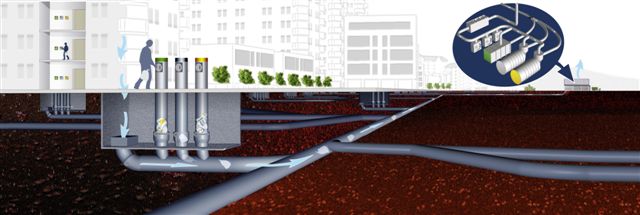
Will the ENVAC style vacuum waste disposal system that also sucks dustcarts off our streets be going in throughout the area? I can find no sign of it in the Vauxhall Square plans (or any drinking water fountains for that matter).

I really, really hope that Wandsworth, Lambeth, the GLA and the developers are putting as much time and effort into making this area a cycling nirvana as they are clearly putting into the hugely expensive Northern Line extension. They are unlikely to get a similar opportunity in the future.


Monday, 9 January 2012

The key to successful shared space with motor vehicles...

is the rising bollard
There's a excellent post on Shared Space streets on 'As Easy as Riding a Bike' and other good posts on several other blogs, not least because this is the subject of this week's Street Talks arranged by the Movement for Liveable London . It gives me a chance to sing the praises of the centre of Bordeaux, which is fantastic to walk and cycle around.

There is the occasional motor vehicle, delivering stock to a shop or removing rubbish. But drivers absolutely know they are guests in the space - they can't enter without sufficient good cause that the bollard is retracted into the ground to allow them to pass. There are very few motor vehicles and the pedestrians stroll as they wish, with cyclists carefully weaving around them.
If only Exhibition Road could be like this

Monday, 19 December 2011

Oil smudges decision making?

STEP ONE: Check out the authors of this letter published by the Guardian on 11th December. 

We are writing to express our concern at the new parking policies which Westminster council are planning to introduce from January which will extend hours of parking control in the West End from 6.30pm to midnight from Monday to Saturday, and from 1pm to 6pm on Sunday. This is likely to have a serious impact on our visitors and audiences at a time when arts budgets are already being severely challenged by cuts in government spending. Westminster council states that these proposals are being introduced "on an experimental basis", and we call on them to reconsider policies which will have such a detrimental effect on the success of cultural organisations in Westminster and the economy of London in general.
John Berry Artistic director, English National Opera, Sandy Nairne Director, National Portrait Gallery, Tony Hall CEO, Royal Opera House,Ian Blatchford Science Museum, Julia Peyton-Jones and Hans Ulrich Obrist Co-directors, Serpentine Gallery, Julian Bird CEO, The Society of London Theatre, Nicholas Serota Director, Tate, Martin Roth Director, V&A

STEP 2: Compare the list of institutions I've put in bold above against today's news report from the BBC:


BP pledges £10m art sponsorship


Oil giant BP says it will continue to sponsor the British Museum, the National Portrait Gallery, the Royal Opera House and Tate Britain, pledging £10m over the next five years.

Tuesday, 29 November 2011

Westminster Council and congestion

There's an excellent article in the Standard that explains the need for car sick Westminster to have its streets totally totally jammed with cars - it's what allows them to set a low Council Tax. Lambeth by contrast has much less available parking so more people walk, cycle and use public transport.

What the article doesn't point out is how cheap it is for Westminster residents to park their car, with an annual permit for a 1200cc plus car costing a mere £115 online.

In Lambeth's congestion zone area the cost is between £136 and £247 for equivalent vehicles (you'll pay more for your V8 Range Rover than in Westminster) if you live inside the Congestion Zone, and £149 to £260 outside it.

The knock on effect to Lambeth residents of Westminster's addiction to drivers is Vauxhall gyratory and its ilk.

Monday, 28 November 2011

An exciting tube project in Vauxhall (beyond the Northern line)

The BBC reports today the Governments multi-billion pound investment programme, including the Northern Line extension to Battersea, saying the government will consider allowing local authority borrowing against the Community Infrastructure Levy to support the scheme, subject to a commitment from a developer to contribute and develop the site.

It's a different tube project that I want to talk about:

One of the most inspiring things I heard at the Vauxhall, Nine Elms, Battersea (VNEB) exhibition is the research undertaken into having the rubbish from all the new buildings removed by vacuum tubes rather than dust carts.

It sounds like science fiction but Sweden's Envac have 50 years experience of doing just this. And if it still sounds fanciful for this huge development project, they're working right this moment on a project of equivalent scale in Helsinki - with recycling thrown in of course.

How can this kind of scheme be encouraged and nurtured? The obvious starting point is to impose a limit on motor traffic, a vehicular 'gastric band'. That will bring this kind of imaginative thinking from pipe dream to pipe reality. Good grief, you'd even see drinking fountains and taps at railway stations as the sane replacement to lorry transported bottled water .

There's a load of guff talked by Boris about equality - giving people the choice to choose their mode of transport. The reality is that most kids and many other people would love to cycle to get to where they want to go but don't because the volume and speed of motor traffic,the lousy road layout, and the aggression of drivers make it an unequal option.

The way to liberate people to cycle and walk in the city is quite simply to throttle motor traffic and give the direct and easy route to the cyclist and pedestrian. Limit the capacity to the motorist, make them go around a maze or the M25 to get to their destination. But give the cyclist and pedestrian their desire line; give them cashpoints and drinking fountains, attractive shop frontages (or better, book and stuff library frontages) and riverside views. Put in loads and loads of hire bike docking stations.

Sure there'll still be a quantity of really unavoidable motor traffic but a lot will simply evaporate, as the dust cart example shows, and as the Netherlands have proven.

There are wider actions too, including making sure the planning regulations support local businesses, by providing affordable housing and workshop space alongside the swish apartments, rather than forcing them out of town resulting in vans and lorries trundling for miles and miles through residential streets just to get to inner London.

The plans for residential properties need to nurture active travel. If it's easier to jump in the car or in a cab than on the bike the design is failing.

VNEB can be the new Amsterdam.

A really good first action to implement in the next month or two with a bit of white paint and a couple of signs is for TfL take away one of the southbound lanes on Vauxhall Bridge from motor traffic so that the UNBELIEVABLY DIRE cycle lane becomes a delightful wide cycling boulevard instead. I've used the cycle lane twice recently on weekdays at 3.30pm and it made everything clench up. I can't believe that anyone responsible for roads could conceivably have cycled it and not immediately condemned it. What were the traffic 'engineers' who dreamt up such a monstrosity thinking, and why wouldn't a cycle friendly Mayor dramatically improve it immediately?

Tuesday, 11 October 2011

Who drives over Blackfriars Bridge?

There are people who argue that the only motor traffic in central London is 'essential', that there is no possible way they can use a form of transport friendly to other people and the environment.

Of course, if splendidly convenient, safe car parking is provided in abundance then use of the car is even more likely to become 'essential'.

Tucked away in discrete coutryards behind Unilever House at the Blackfriars Bridge junction, where LCC are flashriding tomorrow night, are the lawyer's chambers of Inner Temple. Here are a couple of pictures, looking one way:

 and looking the other:
An additional reason (should one still be needed) why I'll be on Blackfriars Bridge tomorrow evening from 5.45.

Thursday, 21 July 2011

Demand drinking fountains at Waterloo

94,000,000 litres of bottled water are sold in London each year with a clear knock-on effect on traffic volume and pollution that drinking fountains and taps don't have.

Lambeth Council has two planning/development policies for Waterloo Station and area out for consultation, both ending this Friday 22nd July at 5pm and you might consider dropping the council an email, such as the draft below, asking them to build in a requirement for prominent free drinking water fountains/taps to reduce the dependency on bottled water.


The email, with your name and address at the bottom, should be sent to  MTrevethan@lambeth.gov.uk


Please can the Draft Waterloo Area Supplementary Planning Document and the Waterloo Station and Interchange Draft Development Brief be amended to ensure the prominent and abundant provision of freely available drinking water (fountains or taps) within Waterloo to reduce the traffic, waste, pollution and expense associated with bottled water. It is appalling that Waterloo Station has no public water fountains/taps, given the number of tourists and commuters passing through. Equally the entire South Bank appears to have no working water fountains/taps for public use. Please build in a condition that these taps are not hidden away but are positioned and promoted to the standard that the bottled water manufacturers and retailers achieve.

Tuesday, 12 July 2011

Lambeth Cabinet approves Transport Local Implementation Plan

The draft Transport Local Implementation Plan (LIP) was accepted In June's Lambeth Council Cabinet Meeting and was submitted to Transport for London. The Head of Transportation highlighted that this was a twenty year plan but that it also contained two year projects to design and develop community level plans.

A copy of the LIP and the results of the Public and Stakeholder Consultation on the first can be found as item 5 in the meeting papers


I find the results from the Consultation very encouraging, not least because a lot of people responded.
 1600 questionnaires were sent to a sample of properties in each of Lambeth’s 21 wards and a total of 762 were returned. There were also 243 online responses making a total of 1005 responses. 

The feedback was as follows:
The response to Lambeth’s Road Danger Reduction policy (by reducing the number and speed of motor vehicles) was positive with 89% expressing support.

The response to Lambeth’s new ‘neighbourhood’ approach (that introduces a range of improvements to public spaces rather than single measures to individual streets) was also positive with 82% supporting the policy. Those who provided comments felt that it would help the council to deliver better value for money and show that the council viewed Lambeth’s streets as community spaces and not just a ‘transit zone.’


In the main there was a high level of support for the TRANSPORT OBJECTIVES in the draft LTP with between 90 and 94% support for all of the goals, as follows:


Improve air quality 94%
promote sustainable healthy travel 94%
Reduce real and perceived danger on Lambeth’s roads 91%
Improve the condition of principal roads 90%
Reduce CO2 emissions 90%

All of the DELIVERY ACTIONS set out in the draft LTP received majority support with improving public transport, tackling inconsiderate driving and promoting sustainable transport being the most popular.

Improve public transport via TfL 95%
Tackle inconsiderate driving 93%
Promote sustainable and safe transport 93%
Improve public spaces for pedestrians 89%
Educate motorists to the danger they pose 86%
Improve cycle access 83%
To reduce and slow traffic 80%
Provide secure cycle parking 80%
Promote cycle training 79%
Tackle inconsiderate cycling 79%
To promote use of electric vehicle 63%
Increase the use of Car Club bays 59%

Four key priorities emerged from the general comments received.
1. Cyclists and those wanting to ride should be made to feel safer through dedicated cycle lanes, giving cyclists priority on the road and better promotion of cycling.

2. The condition of principal and secondary roads should be improved to reduce road danger and to encourage more residents to walk and cycle.

3. Traffic in the borough should be reduced and slowed particularly in residential roads. However, alternative methods of speed management other than physical traffic calming measures should be considered

4. Public transport fares should be reduced to make public transport a viable alternative to motor vehicle travel.
A nice walk in Green (Car) Park


The policeman who approached me as I was taking photos told me that he had never seen as many cars at a Royal Garden Party as there were today, which is no doubt why they'd taken over Green Park itself.

Of course giving 8000 guests free car parking in central London slap bang by their destination, where no buses run, is one hell of an inducement for these worthy recipients of the Queen's largesse (National Trust and RSPB members no doubt) to drive rather than take public transport. I wonder what incentives are given to encourage these day trippers to use sustainable transport - free or discounted rail fares? A special shuttle bus from the London Terminii? Bugger all?

Anyway, what's the royal protocol on where you put all these cars? First of all you appropriate the cycle path.


When that's full you take over the park itself.

What you don't permit on any account is on-road parking on the multi-lane Mall.
Blimey, the police have kept that clear. They've clearly failed on Horseguards Road though where you can rely on the Aussies to take a stand in favour of climate change.

Thursday, 7 July 2011

Free Range Kids - signs of the times

 I teach on-road cycling to children at a number of schools in Westminster and these new images from two different organisations strike a real chord with me in the parked-up, congested, noisy, polluted environment they live, work, play and travel in. Sustrans has hit the nail on the head with 'Free Range Kids' - please take the action they recommend. I'd also advocate joining the Climate Rush cycle flash mob from Soho Square on Wed 13 July at 6.30pm who use the image below.

Thankfully Westminster council is considering introducing Sunday parking fees and restrictions in Mayfair, Marylebone and Soho. Unbelieveably the churches, who one expects to be in favour of stewarding the Creation rather than destroying it, are objecting to this with at least one boasting that half its congregation drive to church!


The Rev Roderick Leece, rector of St George's in Hanover Square, has launched a petition against the plan and says he has thousands of supporters.

He said: "We need a campaign to stop this destructive move. Where Westminster leads, other councils will follow. If Sunday parking restrictions become the norm this could have an effect on many other inner-city churches and cathedrals.

"At least half of our average congregation drive to church on a Sunday. Having to find a parking bay and pay £4.40 per hour will deter a number of worshippers."

Doh! They could walk, cycle or use the excellent public transport service.
These petrol heads are meeting the Council tonight at the church at 7.45 - some dissenting voices would be good

Wednesday, 22 June 2011

Locals, Demand road charging for Vauxhall

The London Assembly Transport Committee has published a report, The Future of Road Congestion in London. The Conservatives dissented from the majority view on Road User Charging, saying (appendix 2),
There is no occasion when a large London-wide road user charging scheme should be introduced. Any introduction of a road user charging system should be limited to small, local schemes which have the support of local people.

A hands-up survey at the recent Lambeth Community Forum concerning the Vauxhall, Nine Elms, Battersea Opportunity Area showed massive support for making Vauxhall a more pleasant place for people to live. Local residents want the volume of motor traffic to be reduced and the Vauxhall Gyratory and its sprawl of motorway-style lanes tamed.

Instead they want Vauxhall to be a place where it is enjoyable to stroll and ride, with outdoor cafes in fresh air and streets returned to two-way working. Transport for London consider this achievable by cutting a third of the existing traffic.

So, a wonderful opportunity exists for the Conservative Mayor of London to have a local vote on a small, local scheme: to charge motorists choosing to use the Vauxhall Gyratory a sum sufficient to deter a third of them, with the income contributing to the replacement of the gyratory with a more liveable streetscape.

It'll meet the 'localism' agenda of the government, endorsed by the Conservative Assembly Members within London, while meeting the desire to remove the gyratory expressed by Lambeth Council, local Assembly Members and the locals.


Win-Win! Who arranges the vote?


Friday, 17 June 2011

A way forward for the future?

If you didn't catch Andrew Marr's Megacities programme last night on sustaining the city, which gives you all the reasons you could wish to have to increase cycling and decrease mindless consumption, please make the time to watch it on BBC iplayer and encourage others to do likewise
http://www.bbc.co.uk/iplayer/episode/b011w7xm/Andrew_Marrs_Megacities_Sustaining_the_City/

Tuesday, 14 June 2011

Motor traffic banned from Waterloo Bridge

 Waterloo Bridge was a pleasure to cycle across today - quiet, unpolluted, spacious. For a moment I thought that TfL were making amends for their disgraceful behaviour on Blackfriars Bridge, but it transpired that no credit was due to TfL - a fire in Aldwych was the cause.