Showing posts with label Consumerism. Show all posts

Friday, 5 May 2017

People really are rubbish, so organisations must change

The Castle Leisure Centre opened at Elephant and Castle last year and I have been to the pool there many days this year. There are bins throughout the centre, with recycling ones next to general waste bins. I've been amazed over the months at the failure of people to sort their rubbish. Those people who bother to put empty shampoo or water  bottles in the bin seem to do this randomly, about half go in the bin labelled plastics and half in the general waste bin adjacent.

At Taunton station last week I saw the clearest attempt I have seen yet to help people simply sort their rubbish.
Every waste bin has one recycling bin adjoining it, and clear directions are given on what to put where should you be in doubt. 
  Look inside the bins though and you can see that people just don't care at all. There is no appetite amongst consumers to take the tiniest step to sorting their rubbish. They just bung it in a random bin or drop it on the platform.


I can't see any other option than to transfer legal responsibility to the manufacturers and retailers to resolve the waste problem their products create, and so what if it means they must pay people, either directly or via taxation, to sort the waste. The businesses will also need to pay for the cost of enforcement, with significant penalties for non-compliance.


Monday, 26 September 2016

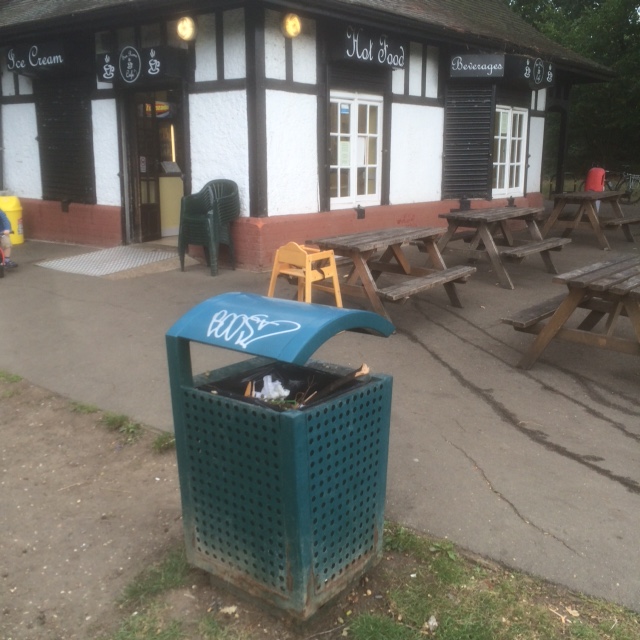
The Bins of Tooting Common - The Cafe

This is the first of an occasional series on the bins of Tooting Common (just joking, one blogpost is surely enough for anyone on this subject).

Here's the cafe, and you can just make out three bins in the photo - green, yellow and red

Here's a close up of the red one, sponsored by Walls

and here's the yellow one, courtesy of Lipton

Also within throwing distance is this big bin

and these two bins - dog poo and, is it finally the recycling bin?

Nope, a general litter bin

 It may be that all rubbish collected on Tooting Common is sorted for recycling, or maybe a clause in the cafe's lease requires the managers to extract recyclable items within a 100m radius of the cafe  (in either case why not say 'waste and recycling bins').

Or maybe none of the plastic bottles, aluminium cans etc. are recycled from here at all. Maybe the litter dropped on the ground is sorted for recycling, which is why people drop it near all these bins.

Who knows? Who cares?

UPDATE
I emailed the Parks contractor for Wandsworth (Enable Leisure and Culture) yesterday and had a prompt reply:

When the last trials took place people used the recycling bins for general waste and we were unable to recycle any and all went as general waste. If the café have there own bins it is their responsibility to dispose of the waste arising from them.
There is no allowance in the Parks Maintenance contract to recycle litter waste but we do ask our contractor to do this where ever possible which is not that often because of the sorting costs involved.
When Friends Of Tooting Common conduct their litter collections they do segregate recycling and take this off of the common. 
So if you care about recycling and see a can or a bottle thrown on the ground or in a bin, please pick it up to take home to put in your domestic recycling.

Friday, 17 June 2011

A way forward for the future?

If you didn't catch Andrew Marr's Megacities programme last night on sustaining the city, which gives you all the reasons you could wish to have to increase cycling and decrease mindless consumption, please make the time to watch it on BBC iplayer and encourage others to do likewise
http://www.bbc.co.uk/iplayer/episode/b011w7xm/Andrew_Marrs_Megacities_Sustaining_the_City/

Monday, 28 March 2011

Where are the cars and taxis in Disneyland?

From Royal Weddings to Olympic Games, the London Eye to Big Ben, the British Museum to Hyde Park, it is hard to envisage central London as anything other than a massive theme park - a delight for its residents and tourists alike. Except that a significant off-kilter aspect of London that proper theme parks don't have is the preponderance of noisy, polluting, space absorbing motor traffic.


But much of that can be designed out. The bicycle replaces the car; B-Bikes and Pedicabs replace taxis and minicabs. A similar hire system to B-Bikes could be introduced with mobility scooters for those unable to use these.

Deliveries could be slashed (maybe fanciful, but how about banning consumable crockery in central London for example - you lose a load of waste refuse collection as well as delivery vans. If you install taps and water fountains rather than bottled water sales outlets you can dispose of thousands of lorry journeys).

There are two posts other bloggers have written today that I urge you to read:
http://waronthemotorist.wordpress.com/2011/03/27/streets-versus-democracy
and
http://ibikelondon.blogspot.com/2011/03/why-mayor-and-tfl-are-wrong-about.html
- check out the video on this and imagine if the private cars and taxis in the clip were removed. How much saner London would be.

Friday, 14 January 2011

Boycott Mitsubishi

Any conglomerate crass enough to market aggressive looking trucks with names such as 'Warrior' and 'Barbarian' deserves to be boycotted by cyclists.

Just in case you need a further reason,  Mitsubishi own Prince's, the Tuna retailers being panned by Hugh Fearnley-Whittingstall and Greenpeace.

Other Prince's brands to avoid are Aqua Pura, Cookeen, Crisp 'n Dry, Napolina, Olivio, and Ocean Spray.

Tuesday, 30 November 2010

Throwing £31m away each year

At a birthday party last weekend I was gobsmacked when this sparkling, musical birthday fountain was produced only to be thrown away about one minute later. Once lit, the flower sparkles whilst the petals slowly open lighting the candles around. At the same time, the "Happy Birthday" tune starts playing. There were no details on the packaging about replacing the pyrotechnic so this contraption is clearly intended to be used once then thrown away, batteries (yes, two) and all.

Lambeth Council is working out what services are for the axe as it's being forced to make cuts of £79m over the next 4 years.

It costs £31m a year to collect and dispose of Lambeth's rubbish (£113 for each of the 272,000 residents) so it's clear to me that the sanest way to protect essential services is to cut down the amount of crap we mindlessly consume.

What's this got to with riding a bike? Well, first of all we'll have fewer lorries on the streets...

Secondly, it gives me a chance to mention Lambeth Freecycle - the Yahoo group for giving and collecting unwanted items. When we use it we normally give preference to people collecting on foot/public transport or by bike.

Thirdly, if you're reading this shortly after it's been posted, there's still time to vote for the Council to provide funding to kickstart the Brixton Reuse Centre (including bicycles). Deadline for voting is midnight 1st December.

Wednesday, 10 November 2010

PPK volunteer of the week


Pedal Power Kennington has a 'One Planet living' approach. We'd picked up a dumped chest of drawers missing most of its knobs and we came close to losing nails when opening drawers. Dave had a moment of inspiration and found that worn brakes pads screwed straight into the holes! What a great, if aesthetically controversial, result.

This was just one of many inspired diy contributions Dave's made recently, making him even more deserving of the title.

Sunday, 31 October 2010

Veteran and Future Cars in Kennington Sat 6, Sun 7 Nov


This Saturday 6th November sees the RAC's inaugural Brighton to London Future Car Challenge (BLFCC), for Electric, Hybrid and Low-Emission ICE vehicles to use the lowest energy on a 60 mile route from Madeira Drive, Brighton to Pall Mall & Regent Street, London.

10.30 - noon appear to be likely times for these cars to motor through Kennington Road.

Sunday 7th sees the RAC's London to Brighton Veteran Car Run, in Kennington between 07.10 and 09.15.

The annual event takes place on the first Sunday of every November and commemorates the Emancipation Run of 14 November 1896 which celebrated the passing into law of the Locomotives on the Highway Act, which raised the speed limit for 'light locomotives' from 4 mph to 14 mph and abolished the requirement for these vehicles to be preceded by a man on foot.

It's fun looking at a few ancient or future cars. It's when you multiply up the numbers that it becomes apparent that congestion and huge environmental damage must result even if you make vehicles superficially greener - and yes, that is an electric Range Rover competing.

In 2009 there were 61,792,000 people in the UK with a staggering one car between every two people (all the more staggering since 12m of the population is under 16!)

In 2010 the Telegraph reported there are 31,035,791 cars on British roads, the first fall in numbers since the second world war.

Phew, you may think, people are seeing the light. Don't bet on it:

The RAC Foundation's director, Stephen Glaister, expressed surprise at the figures.
“This is likely to be a blip rather than the start of a trend. The population is forecast to rocket by ten million in the next couple of decades and these people will need to get about," he said.

"We know people are driving less on an individual basis, and lifestyle changes might mean more people working from home in the future, but with nine out of ten passenger journeys already being made on the roads population growth – and economic recovery – will almost inevitably mean more cars.

"The challenge is to make these vehicles greener, and with average new car CO2 emissions steadily falling that challenge is already being met.”


He is wrong. The challenge is to reduce our car dependency and car ownership. Car clubs and hire, public transport, and amenities within active travel distance of people's houses are the sane option.

Many people are scared of walking and cycling due to the aggressive dominance of motor traffic and this needs to be rebuffed. Maybe in a tweak on history, in the future motor vehicles should be preceded by a cyclist - a practice which is already happening in parts of central London ;-)

Cyclists can join in the Veteran Car Run and Young Lewisham and Greenwich Cyclists have a group ride - Kennington residents can intersect with them at East Croydon.

Friday, 8 October 2010

The South Bank is broken

According to the draft South Bank Cycling Strategy the South Bank attracts 17,000,000 visitors a year. That's a lot of people who are likely to be thirsty during their visit.

The riders on the Pedal Power Kennington ride on Wednesday felt thirsty by the time we reached Bernie Spain gardens so we stopped for a drink from the water fountain but it was broken.

I think it's the only one along the South Bank for quite a way - the nearest one I know of is this one between Lambeth and Westminster Bridges which is also broken:

So, one of the marshalls nipped off and bought a bottle of water that had been driven to the South Bank by a great big polluting lorry.

Vroom, Vroom South Bank.

Monday, 4 October 2010

Little steps to fewer lorries


Cutting out one-use items like take-away coffee cups and disposable cutlery means fewer lorries fouling our streets as well as less landfill.

I dropped into the Scandinavian Kitchen (61 Great Titchfield Street, W1W 7PP) a few weeks ago for a good take-away coffee in a Keep Cup for about £4.

The dishwasher suitable Keep Cup fits in a pocket in one of my panniers so it's always with me and I can cycle my take-away coffee off to drink it elsewhere (with an elastic band to ensure the lid stays on the cup over cobbles or pot-holes). I've had no coffee place refuse to serve me coffee in the cup and several have given me a discount (enough to offset the cost of the original purchase).

Visit this blog for further ways to a less disposable lifestyle.

Thursday, 30 September 2010

Reducing the number of lorries in Kennington


It is, of course, more pleasant to walk and cycle without being pressured by motor traffic. Yet many people believe there is no alternative to large numbers of fast moving vehicles delivering stuff.

The irony is that much of the stuff being driven around isn't actually needed. The photo is of the indoor cafe at the Imperial War Museum, one of the areas many tourist destinations. This isn't a take-away kind of cafe and there's plenty of seating. So there's no need to use once-only lifetime stuff (drive it in, use it once, bin it, drive it out).

Why are there stacks of one-use glasses rather than glass or reusable plastic ones?

Why are the serviettes displayed in a 'grab a handful' way, rather than in a single serviette dispenser? In fact, why not have washable napkins?

Why are there plastic knives, forks and spoons when there are metal ones just below?

Why ever would you have wooden drink stirrers when there are teaspoons just below?

Surely there must be reusable straws available?

These kind of establishments normally burble on about lack of space for proper crockery and dishwashers, yet have shed loads of bin space that could serve a more useful purpose. What they can't fit in their bins they arrange to have driven around on our streets to our discomfort.

Monday, 13 September 2010

No Water in Waterloo Station

The draft South Bank and Waterloo Cycling Strategy, written by The South Bank Employers Group (SBEG), aka POMT (Purveyors of Mindless Tat), under the guidance of its members has this sad comment about Lambeth Council's Road User Hierarchy which puts walking first, cyclists next, then buses, rail, taxis, motorcycles, then freight transport with cars last:

...representatives of the larger businesses that rely on HGVs to transport goods to site raise questions about its specific application to the South Bank area.

Network Rail, owner of Waterloo Station, was a member of the report's steering group. Clearly it is important to keep all the retailers in Waterloo Station stocked with essential products.

Just look at the window of that fine newsagents, W H Smiths. Full of essential water driven in by bloody great lorries.


and on the other side


I stopped counting the number of places flogging bottled water in the station when I ran out of fingers, thumbs and toes.

I didn't spot a single tap or water fountain for the thirsty traveller so I asked at Station Information.

Nope I was told, not one. Nowhere.

Network Rail is a non-profit distributing company set up by the Government. So they needn't whinge about needing to screw the planet to appease their fat-cat shareholders.

So WTF can't they ditch the bottled water, get rid of shedloads of HGVs and simply install taps to the pipes I'm sure they already have in the station. (And likewise at Victoria Station which also hasn't drinking fountains or taps .... and probably all the rest they own)

As for the River Walk - there's clearly no rush to fix an existing fountain when the planet killing landowners can extract rent from planet killer stalls and narrow the walkway with yet another A-board into the bargain.